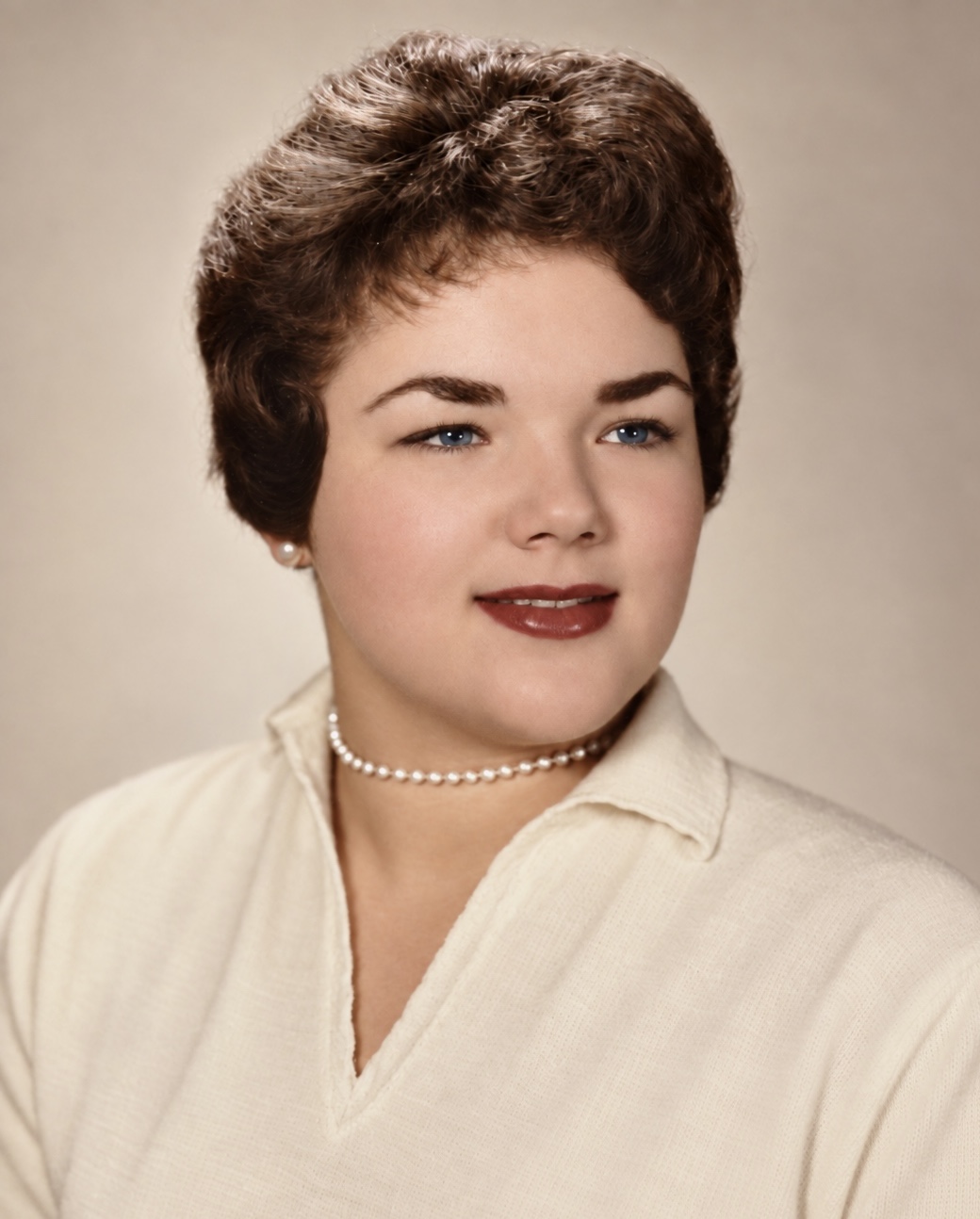

Judith Gail Zeigler
May 27, 1938 – August 23, 2026
Judith Gail Birkhoff Zeigler was born on May 27, 1938, in Los Angeles, California, to Herman and Pearl Birkhoff. She grew up in South Gate with her older sister, Beverly, in a family where work and self-reliance were part of everyday life. Her father worked as a truck driver for XLNT Spanish Food Company, and her mother worked as a seamstress for a company that manufactured crash helmets.
South Gate would remain important to Judy for most of her life. She attended San Gabriel Avenue School through the sixth grade, followed by South Gate Junior High and South Gate High School. She was active from a young age and especially enjoyed music and group activities. During junior high she participated in Glee Club, the A-9 Trio, G.A.A., Gate Service, Y-Teen, and Job’s Daughters. She also served on the School Safety Committee and was recognized in 1953 for her service to the school and community.
At South Gate High School, she continued with Y-Teens and Job’s Daughters and sang in the Rambler Choir.
She also began working while she was still very young. In the ninth grade, she worked part-time as a gift wrapper in a department store. Over the next few years she gained experience as a cashier, desk clerk, and elevator operator, working weekends and holidays while continuing her education. During one summer in high school, she worked as a receptionist in a doctor’s office. She also volunteered twice a week in the recreation department of the Children’s Polio Ward at Rancho Los Amigos, work that she genuinely enjoyed.
By the time she graduated from South Gate High School in June 1956, she had already learned how comfortable she was balancing several responsibilities at once. She had studied stenography because she understood the importance of having practical skills she could depend on, but her stronger interest was in art, particularly advertising and commercial design.
After high school, Judy briefly worked for Mutual Credit Bureau doing typing and light stenography while preparing to attend college. She then enrolled at Compton Junior College, where she majored in commercial art and also sang in the A Cappella Choir. She was interested in lettering, advertising, signs, and other forms of practical design, and she considered continuing on to art school in the future.
Her artistic ability soon became useful far beyond the classroom.
In June 1957, Judy began working for the City of Paramount. She was only nineteen. Paramount itself had incorporated just months earlier, in January of that year, and the new city was still establishing its identity and civic institutions. Judy worked as a clerk typist and later served as the Planning Commission clerk, but one of her most significant contributions came through the artistic skills she was developing in college.
The city had held a contest seeking ideas for a new official seal. Those ideas still needed to be developed into a final design that could actually represent Paramount. Judy became largely responsible for preparing that final draft. The completed design was presented to the City Council and adopted as the official seal of the City of Paramount.
It was an impressive achievement at any age, but especially for a nineteen-year-old college student at the beginning of her working life. The seal incorporated images representing the community and carried the words “City of Progress.” Judy had helped create an official civic symbol for a newly incorporated California city while she was still studying commercial art.
Her creativity also found other outlets. She made signs and advertising materials for people and, during the Christmas season, painted lettering and seasonal scenes on store windows. At the same time, she continued working at City Hall and spent Saturdays working as a food demonstrator for XLNT Spanish Food Company.
Judy was practical about work, but she was never interested only in collecting jobs or filling her schedule. She believed that if she became involved in something, she should have enough time to contribute to it rather than simply benefit from being there. That attitude had already shown itself in her school activities and volunteer work, and it continued into adulthood.
In February 1958, Judy’s father, Herman, died. She was nineteen years old and nearing the end of college. A few months later, on June 19, 1958, she completed her studies and received her Associate in Arts degree from Compton College.
By then, she had already built an unusually broad foundation for someone her age. She had worked in retail and offices, volunteered with children, learned shorthand and typing, studied commercial art, created advertising and display work, worked for a city government, contributed to the design of a municipal seal, and earned a college degree. She was considering additional art education and night school while continuing to work and, like many young adults, thinking about what the next stage of her life might eventually bring.
In the years that followed, another important part of that life began when she met Jerry Marvin Zeigler at a dance in Compton.
Their relationship developed while both were still young and working out what adulthood would look like. When they were apart, they wrote to each other about family, work, the weather, plans, people they knew, things that had happened that day, and when they would see one another again. Their letters preserve the ordinary closeness of two people building a relationship before either could have known how many years they would eventually share.
Judy and Jerry married on March 26, 1960.
They were both twenty-one years old.
Judy continued working for the City of Paramount after their marriage, remaining there until September 1961. Over the years that followed, work and school became part of a much larger life that included marriage, family, children, homes, responsibilities, friendships, and eventually grandchildren.
South Gate remained central to that life. The home there became a place associated with decades of family history, possessions accumulated over time, familiar routines, holidays, friendships, and ordinary days. Judy had known the area since childhood, and the connection she felt to it became stronger rather than weaker as she grew older.
She valued having a home, but what mattered just as much to her was the independence that came with it. Judy liked being able to decide what she wanted to do with her own time. She loved going shopping, browsing through stores, eating out, going on drives, visiting people, and finding reasons to get out of the house. She did not need an elaborate occasion to enjoy herself. Going somewhere, looking around, having lunch, stopping at a store, visiting someone, or finding something interesting along the way was enough.
That desire to be involved remained with her throughout her life. Even in her eighties, she still cherished opportunities to go shopping, see friends, participate in activities, and spend time around other people.
Judy was independent and strong-willed, and she was capable of making her opinions very clear. She had spent most of her life working, caring for people, handling responsibilities, and making decisions for herself. She was proud of what she had accomplished and did not believe that growing older should erase a person’s ability to have a say in their own life.
She was also very funny.
Her humor was rarely something she planned. It came naturally in conversation, through teasing, sarcasm, facial expressions, or the way she reacted to something she found ridiculous. She could be serious one moment and say something unexpectedly funny the next. She could make faces for a photograph, joke about getting older, tease the people around her, or fuss over someone she loved and somehow make that funny too.
Her concern for people often appeared in practical ways. She noticed when someone was not taking care of themselves. She worried about whether people were eating properly, dressing warmly enough, getting medical care when they needed it, or making choices she thought were unwise. She had no problem reminding someone of those things repeatedly if she thought they needed to hear it.
She also had a straightforward sense of fairness. She did not place much value on distinctions that she believed should not matter between people. Race or background did not determine whether she liked or respected someone. What mattered to her was the person and how they treated others.
Animals were another source of affection and enjoyment throughout her life. They brought out a playful side of her, the same side that appears so clearly in family photographs and everyday memories.
As Judy grew older, health problems gradually made some of the things she had always taken for granted more difficult. Changes in her routines and living arrangements also required adjustments after a lifetime of valuing independence, familiarity, and the freedom to decide how she spent her days.
What remained consistent was what Judy wanted from everyday life.
She still wanted to go shopping, eat out, visit people, see friends, participate in ordinary activities, and have reasons to get out of the house. She valued familiar surroundings and wanted to continue having a voice in the decisions and routines that affected her.
For Judy, quality of life meant more than simply being physically safe. It also meant remaining connected to other people, having things to do, making choices for herself, and continuing to participate in the ordinary parts of life that had always mattered to her.
Even during periods of change, her interest in other people remained. She could meet someone new and immediately begin thinking about what she might give them for a holiday. She worried about Jerry’s health. She thought about friends she had not seen. She wanted to remain connected to the people she cared about.
Judy was also proud of what she had accomplished. She knew that she had worked hard throughout her life. She had built a home and family and spent decades caring for people. Even when age changed what she was physically able to do, she had not forgotten what she had already done.
The final year of her life brought a profound loss when Jerry died on March 31, 2026. They had been married for more than sixty-six years.
Judy died less than five months later, on August 23, 2026, at the age of eighty-eight.
Her life had begun in Los Angeles in 1938 and unfolded largely through the communities of South Gate and Paramount. She had grown from an active schoolgirl into a college student studying commercial art, from a teenage department-store employee into a young city employee helping create Paramount’s official seal, and from a young woman beginning her adult life into a wife of more than six decades, a mother, and a grandmother.
She had worked from the time she was a teenager. She had volunteered with children affected by polio. She had sung in choirs, studied art, painted store windows, worked in offices, created advertising materials, and contributed to the visual identity of a new city. She had earned a college degree at twenty. She had built a marriage and family, maintained a home she deeply loved, and remained fiercely interested in the world around her well into her eighties.
The details of Judy’s personality are what made those accomplishments belong specifically to her. She was loving without being overly sentimental, caring without being quiet about it, funny without trying to entertain anyone, and independent without needing anyone’s permission to be so. She could be stubborn, impatient, generous, affectionate, outspoken, playful, and deeply protective of the people she loved.
By the end of her life, she could look back on decades of work, family, marriage, friendships, homes, responsibilities, laughter, and experiences and know that she had built a full life.
In her own words, she had done “pretty damn good.”
She had.
And she had every reason to be proud of it.